




What Is NETD and Why Does It Matter in Thermal Imaging
NETD stands for Noise Equivalent Temperature Difference. It is one of the key specifications used to measure the thermal sensitivity of an infrared detector. In simple terms, NETD represents the smallest temperature difference that a thermal imaging device can detect against its own noise level.
NETD is usually measured in millikelvins. A lower NETD value generally means that the detector can distinguish smaller temperature differences, making it easier to reveal subtle thermal variations in a thermal scene.
For example, under identical testing conditions, a thermal imaging device with an NETD of 15mK has a lower detection threshold than one with an NETD of 40mK. This means the former can provide finer thermal contrast, which is particularly useful when the temperature difference between an animal and its surroundings is minimal.
For hunters and outdoor users, this specification matters when observing animals in environments where their heat signatures may blend into the background.
How Does NETD Affect Thermal Image Quality?
NETD directly relates to thermal sensitivity, but its effect is best understood in real viewing conditions.
Detecting Small temperature differences
Animals, rocks, vegetation, and the ground may all have similar apparent temperatures. When the temperature difference between a target and its background is small, a thermal detector with higher sensitivity helps reveal subtle thermal features.
In certain scenarios, such as observing wildlife near warm rocks or scanning areas where the background temperature is similar to the animal's surface temperature, a thermal imaging monocular with a low NETD value can produce a more pronounced thermal contrast.
However, a low NETD value does not guarantee that every target will be easy to identify. Distance, weather, humidity, target size, and the thermal properties of the surrounding environment also affect the image.
Seeing More Thermal Detail in Difficult Conditions
Thermal imaging devices often face greater performance challenges when the thermal contrast in an environment is low. For example, after the ground and surrounding objects have warmed to similar temperatures, the differences between a target and its background may become less obvious.
In such scenarios, a detector with high thermal sensitivity helps preserve subtle temperature variations. This makes it easier for users to interpret thermal image, although it cannot remove every environmental limitation.
When comparing thermal imaging devices for hunting or wildlife observation, NETD is therefore an important specification to consider alongside detector resolution, lens performance, and image processing.
NETD vs. Resolution: Understanding the Full Picture
A common mistake is to equate NETD directly with image resolution. These technical specifications describe different aspects of thermal imaging performance.
l NETD: A measure of a detector's ability to distinguish between small temperature differences.
l Infrared Resolution: Refers to the number of pixels in a thermal sensor - for example, 640×512.
l Pixel Pitch: The distance between the pixels on a detector, typically measured in micrometers.
l Lens Aperture: Describes the lens's light-gathering capability, often expressed as an F-number.
l Display Resolution: The number of pixels on the screen used to view thermal images.
A device with a lower NETD value can detect subtle thermal contrasts, while a sensor with higher resolution provides a greater number of image sampling points. Neither specification alone determines the complete viewing experience.
What Is a Good NETD Value for a Thermal Imaging Device?
The NETD value is frequently used to compare different types of thermal imaging devices. Common specifications include 50mK, 40mK, 25mK, 20mK, and 15mK.
In general, a lower value indicates better thermal sensitivity under comparable test conditions. A device with a 15mK rating, for instance, can distinguish finer temperature differences than one with a 40mK rating.
However, buyers should not compare NETD values in isolation. Because measurement conditions and testing methodologies can vary between manufacturers, it is advisable to consult the full technical specifications and consider other performance metrics that influence image quality.
For outdoor thermal imaging, a practical evaluation should include:
l NETD: The sensitivity of the detector in responding to small temperature differences.
l Sensor Resolution: The ability of the infrared detector to capture spatial details.
l Lens Specifications: How focal length and aperture influence the field of view and image collection.
l Image Processing: The device’s capability to enhance contrast and suppress unwanted image noise.
l Display Quality: How clearly the thermal image can be viewed.
Looking at these specifications together provides a more realistic picture of overall performance than focusing on a single number.
Why Detector Resolution and NETD Should Be Evaluated Together
Thermal sensitivity and detector resolution work together, but they are not interchangeable.
A thermal imaging sensor with a 640×512 resolution contains more pixels than one with a 400×300 resolution. When combined with factors such as the lens, observation distance, and image processing system, the former can provide more spatial information about a target. NETD, on the other hand, describes how well the detector can distinguish small temperature differences.
When comparing thermal imaging monoculars, it is important to clarify your specific observation needs. If your priority is identifying subtle heat patterns, thermal sensitivity matters. If you need more spatial detail when examining a target, sensor resolution and lens configuration are also important.
The final image quality is determined by the interplay between the infrared detector, optical lens, image processing system, and display screen. A well-balanced thermal imaging system should be evaluated as a whole rather than by one specification alone.
How Kodiak 3.0 Uses a 15mK NETD Detector
The Guide Kodiak 3.0 series of thermal imaging monoculars combines a 15mK NETD rating with a 640×512 infrared resolution. These specifications are designed to capture subtle thermal differences, delivering highly detailed thermal imagery for hunting and outdoor observation.
The series includes two models with different lens configurations:
l TK635L 3.0: Equipped with a 35mm F0.9 lens and a 12.5° × 10.0° field of view, making it suitable for users who want a wider viewing area.
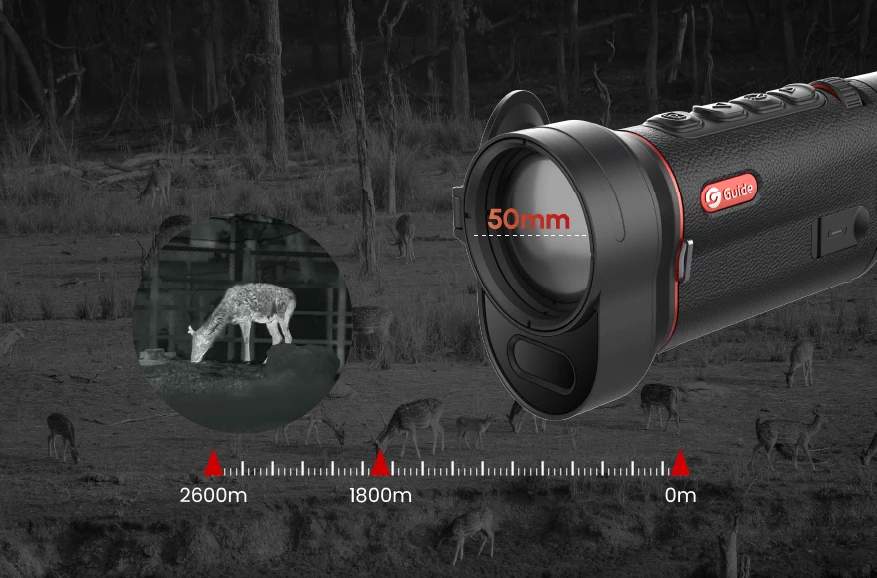
l TK650L 3.0: Equipped with a 50mm F0.9 lens and an 8.8° × 7.0° field of view, offering a narrower view suited to longer-distance observation.
Both models feature a 50Hz frame rate, a 1.03-inch AMOLED display with a resolution of 2560×2560, and a built-in laser rangefinder with a range of up to 1,200 meters. This series also incorporates Shutterless 3.0 technology.
These features serve different purposes. The 15mK NETD specification relates to thermal sensitivity, the 640×512 sensor provides spatial image information, and the lens determines the field of view and helps shape the observation experience. Taken together, the Kodiak 3.0 series is well worth considering for users who prefer to evaluate thermal imaging performance based on a comprehensive set of technical specifications.
Conclusion
NETD is a key specification for evaluating the sensitivity of thermal imaging devices. A lower NETD value generally indicates that the detector can distinguish smaller temperature differences, which helps reveal subtle thermal features in low-contrast environments.
However, NETD does not measure resolution, detection distance, or overall image quality on its own. When selecting a device, users should also consider factors such as infrared resolution, pixel pitch, lens specifications, image processing capabilities, and display quality.
With its 15mK NETD, 640×512 infrared sensor, and two lens options, the Guide Kodiak 3.0 series illustrates why it is useful to assess thermal imaging equipment through a combination of technical parameters rather than a single headline specification.