
.png)
.png)
.png)






Thermal Imaging Basics: What Is NETD, Resolution, LRF Explained
Comparing different thermal imaging devices for the first time can seem a bit complex. Terms like NETD, thermal resolution, and LRF frequently appear in product specifications, but what do these parameters actually mean?
For beginners, understanding these basic parameters is more useful than simply looking at the longest detection range or highest specification.
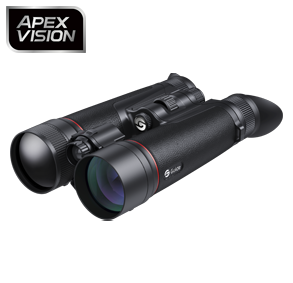
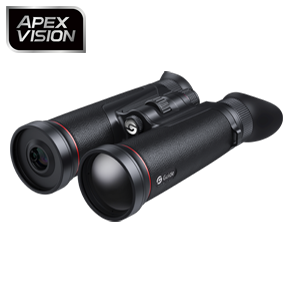
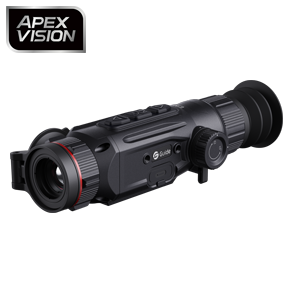
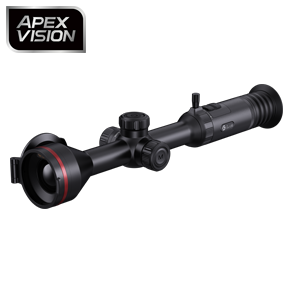
Whether you're buying a thermal imaging monocular, thermal imaging scope, thermal imaging binoculars, or other thermal imaging equipment for hunting and outdoor activities, understanding these terms will help you make a better choice.
What is Thermal Imaging?
Thermal imaging technology converts temperature differences into images by detecting the infrared radiation emitted by objects.
Unlike traditional cameras, thermal imaging does not need visible light, making it useful in darkness and low-light conditions.
However, different thermal devices provide different image quality. This is where NETD and resolution become important.
What is NETD in Thermal Imaging?
NETD stands for Noise Equivalent Temperature Difference.
Simply put, NETD describes a thermal imaging sensor's ability to detect small temperature differences. It is usually measured in mK.
A lower NETD generally means better thermal sensitivity and contrast. For instance, it helps reveal subtle temperature differences between an animal and its surroundings.
This is highly beneficial for hunting and outdoor observation, particularly when the target has weak thermal contrast.
NETD should not be considered alone. Factors such as lens quality, resolution, image processing, weather, and observation conditions also affect the final image quality.
Why is NETD Important?
A lower NETD helps provide:
l Superior thermal sensitivity
l Clearer temperature differences
l Higher image contrast
l More visible details
For beginners, a simple rule is: when comparing similar thermal imaging devices, a lower NETD is generally better.
What is Thermal Resolution?
Thermal resolution refers to the number of pixels in a thermal imaging sensor.
Common resolution specifications include:
l 256×192
l 384×288
l 400×300
l 640×512
Generally, higher resolution results in more image detail, making it easier to observe and identify targets at long distances.
For example, a 640×512 sensor generally provides more image information than a 256×192 sensor.
However, resolution is not the only determining factor. Lens quality, NETD, image processing, and target distance all affect the final viewing experience.
For hunters, higher resolution can be useful when observing animals at longer distances or in complex environments.
What is LRF?
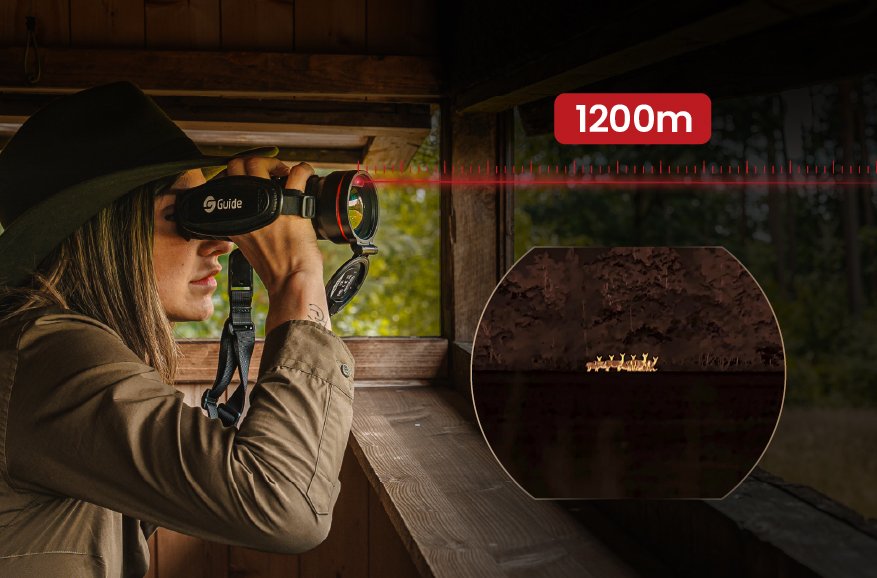
LRF stands for Laser Rangefinder.
Unlike NETD and thermal resolution, LRF is a ranging function.
A laser rangefinder uses a laser to measure the distance between the device and a target, with the measurement typically displayed on the screen.
For hunters, an LRF makes it easier to measure the distance to an animal, eliminating the need to rely solely on visual estimation.
Performance varies depending on the target, distance, weather conditions, and device design.
NETD, Resolution, and LRF: What’s the Difference?
These three parameters serve different purposes.
NETD relates to thermal sensitivity and the ability to detect small temperature differences.
Resolution relates to image detail and the amount of thermal imaging information captured by the sensor.
LRF relates to distance measurement.
In short:
l NETD = Thermal sensitivity
l Resolution = Image detail
l LRF = Target distance
They should not be compared as if they measure the same thing, because they solve different aspects.
Which Specifications Should Beginners Focus On?
There is no single specification that is the most important for every user.
If image detail is your top priority, focus on thermal resolution.
If you need greater sensitivity to small temperature differences, look at NETD.
If knowing the distance to the target is important, a built-in LRF offers additional value.
For hunting and outdoor applications, it is best to consider a combination of specifications. You should also take into account factors such as lens size, detection range, Field of View, battery life, image quality, and weight.
Why Understanding Thermal Specifications Matters
For beginners, the technical specifications of thermal imaging devices can often be overwhelming.
A device with a long advertised detection range does not necessarily offer the best image clarity; likewise, a high-resolution sensor requires a high-quality optical system and image processing system to deliver outstanding performance.
Understanding key parameters such as NETD, resolution, and LRF provides users with a better basis for evaluating thermal imaging devices.
Guide Outdoor provides thermal imaging solutions for hunting and outdoor applications, helping users select the most suitable equipment based on their specific observation needs and environments.
Conclusion
NETD, resolution, and LRF are three key terms that beginners should understand.
NETD reflects thermal sensitivity, resolution determines image detail, and LRF is used to measure the distance to a target.
These specifications should not be considered alone. A suitable thermal imaging device should strike a balance between sensor performance, image quality, lens capabilities, and practical features, tailored to specific application scenarios.
Once you understand these basic parameters, comparing thermal imaging products becomes much easier.












.png)

.png)
