
.png)
.png)
.png)





Short-Range vs. Long-Range Thermal Scopes: Which Is Right for Hunting
When choosing a thermal scope, you should not focus only on the model with the longest detection range. For hunters, the more important questions are: What distance do you normally hunt at, and how do you use your scope in the field?
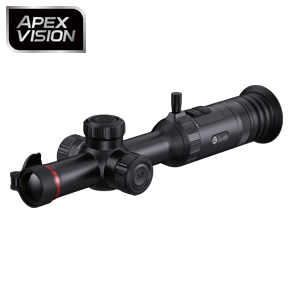
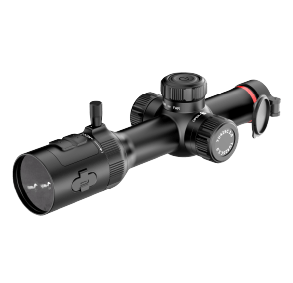
A short-range thermal scope and a long-range thermal scope are designed for different hunting situations. The right choice can make scanning easier, target observation more comfortable, and your equipment more useful during a real hunting trip.
Start With Your Typical Hunting Range
The first thing to consider is where your targets usually appear.
If your game typically stays within close range, a short-range thermal scope may be enough; there is little need to choose a scope designed for long-range targets if most of your hunting happens closer to your position.
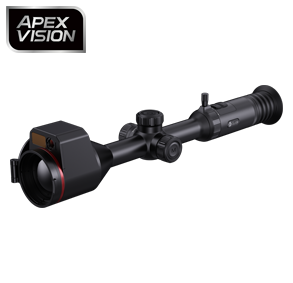
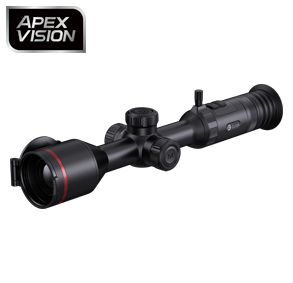
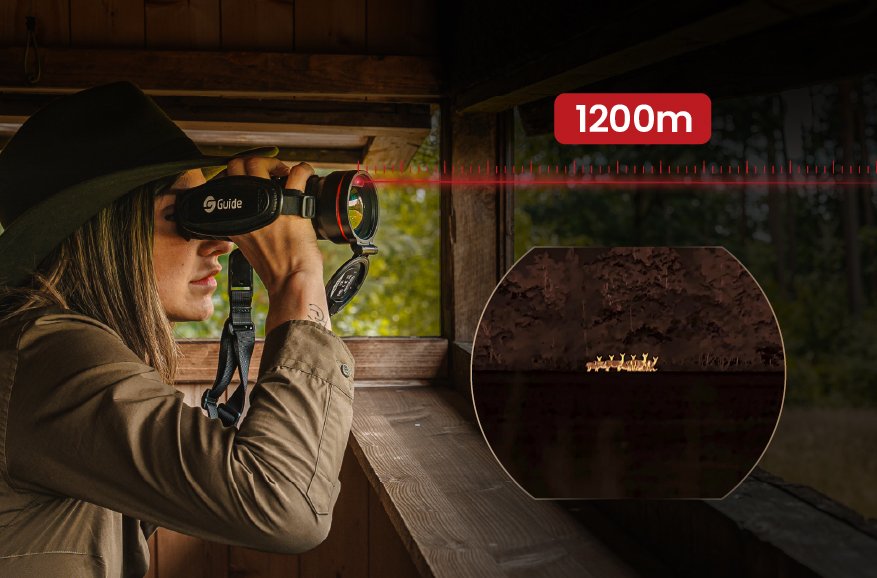
On the other hand, hunters who frequently need to spot game across large open areas may require a long-range thermal scope. A longer focal length and higher-resolution thermal sensor can help you detect and observe heat signatures at greater distances.
Instead of asking, "How far can this thermal scope see?", ask yourself, "How far do I usually need to see?"
This simple change can make the buying decision much easier.
How Focal Length Affects Hunting Distance
Focal length also affects how a thermal scope performs at different hunting distances. A 25mm thermal scope generally provides a wider view for closer-range hunting, while a 35mm scope offers a good balance between field of view and reach. A 50mm thermal scope provides a more focused view and is better suited to longer-range hunting.
However, focal length should be considered together with thermal resolution, sensor size, and magnification. The longest focal length is not always the best choice - it should match your typical hunting distance.
For a closer comparison of 25mm, 35mm, and 50mm thermal scope lenses, see our guide: Thermal Scope Lens Size: 25mm vs 35mm vs 50mm Explained.
Consider How You Scan the Hunting Area
Scanning is a major part of night hunting.
When searching for game, you may slowly move the scope across the area, stop at likely locations, and check movement or heat signatures.
Short-range thermal scopes are highly practical for hunters who frequently scan nearby areas and need to react quickly when game appears.
Long-range models are more suitable if you need to spend significant time observing specific distant areas. They can be useful when animals are expected to remain farther away rather than suddenly appearing nearby.
Therefore, your scanning habits should also be a factor when making your purchase decision.
Consider the Size of the Hunting Area
The size of the hunting area also influences your choice.
For smaller hunting grounds, extreme observation ranges are not necessarily required. A short-range thermal imaging scope is sufficient to meet your needs without adding unnecessary features.
The situation differs for large hunting areas. When scanning vast, open terrain, a long-range thermal imaging scope allows hunters to observe distant areas without frequently changing their position.
This is particularly useful when game tend to stay far away from roads, trails, or other common observation points.
The Impact of Target Movement Cannot be Overlooked
Animal movement is another factor that is easily overlooked.
Tracking a fast-moving target within the field of view can be difficult if excessive magnification is used. You may lose the animal from the image while trying to reposition the scope.
For targets moving at close range, a simpler setup can sometimes be easier to manage.
Long-range thermal scopes are better suited for scenarios where targets are distant and there is ample time for observation.
This does not mean one type is always better. It means the scope should match the way the animals behave in your hunting area.
Choosing a Thermal Scope That Matches Your Hunting Style
Different hunters use thermal scopes in different ways.
Some hunters spend most of their time moving around and patrolling various areas, while others remain in a fixed position, observing expansive terrain.
For hunters who are constantly on the move, a compact thermal scope is often more portable and practical; carrying large, long-range equipment is usually unnecessary if most targets appear at close range.
Conversely, for hunters who stay in a fixed position and monitor distant areas, a long-range thermal scope is the better choice.
Your hunting style is just as important as the technical specifications listed on the product page.
Do You Really Need the Maximum Detection Range?
A common mistake is choosing a thermal imaging scope simply because it has the highest advertised range.
Maximum detection range is just one of many technical specifications. Real-world performance can change with weather, vegetation, target size, lens quality, and thermal resolution.
Hunters may not necessarily use the extreme detection ranges offered by expensive long-range scopes.
In some situations, a simpler thermal scope that fits the normal hunting distance can be more practical.
For this reason, choosing a scope based on your actual needs is often better than simply chasing the highest numbers on a spec sheet.
Short Range or Long Range: Which One Fits You?
A short-range thermal scope might be the better choice if you:
l Hunt mainly at closer distances
l Need to move frequently between hunting spots
l Track animals active in the immediate vicinity
l Prefer a compact and lightweight gear setup
l Rarely observe targets at long distances
A long-range thermal scope might be more suitable if you:
l Hunt across large open areas
l Frequently observe animals at a distance
l Conduct observations from a single location for extended periods
l Need to identify various heat signatures at long range
l Regularly hunt at longer distances
Conclusion
When choosing between short-range and long-range thermal imaging scopes, base your decision on your actual hunting habits rather than simply relying on the maximum range stated on the packaging.
Short-range models can be practical for hunters who work at closer distances, move frequently, or encounter animals that appear and move quickly.
Conversely, long-range models are better suited for hunters who prefer observing vast areas and distant targets from a fixed position over extended periods.
Before buying, consider factors such as your normal hunting range, observation habits, target movement patterns, the hunting environment, and the gear you can comfortably carry.
The best thermal scope isn't necessarily the one with the longest range; it is the one that best aligns with your specific hunting style.












.png)

.png)
